L'Étranger (2025)
A movie review, hastily written. 4.5/5

“Maman died today.”
Those are the words with which The Stranger, Albert Camus’ debut novel opens. There is a repertoire of opening sentences that stick with us permanently as readers of literature. The snowflake on the dying woman’s coat at the end of Joyce, the convict in the marsh fog in Dickens, the wormy citrus on the table in García Márquez. Camus’s Aujourd’hui, maman est morte belongs to that lineage, and is lodged so deep in the bone of literary memory. The Stranger is a book so dense with the loneliness of its own interior monologue that one half-suspects no camera could survive it. I was told I was wrong for thinking this by one of my poetry teachers, Aaron Van Jordan, and so I decided to go watch it with my close friends Uzay, Janet and Asher at the Roxie.
[Many spoilers ahead if you haven’t watched the movie or read the book! I talk about both.]
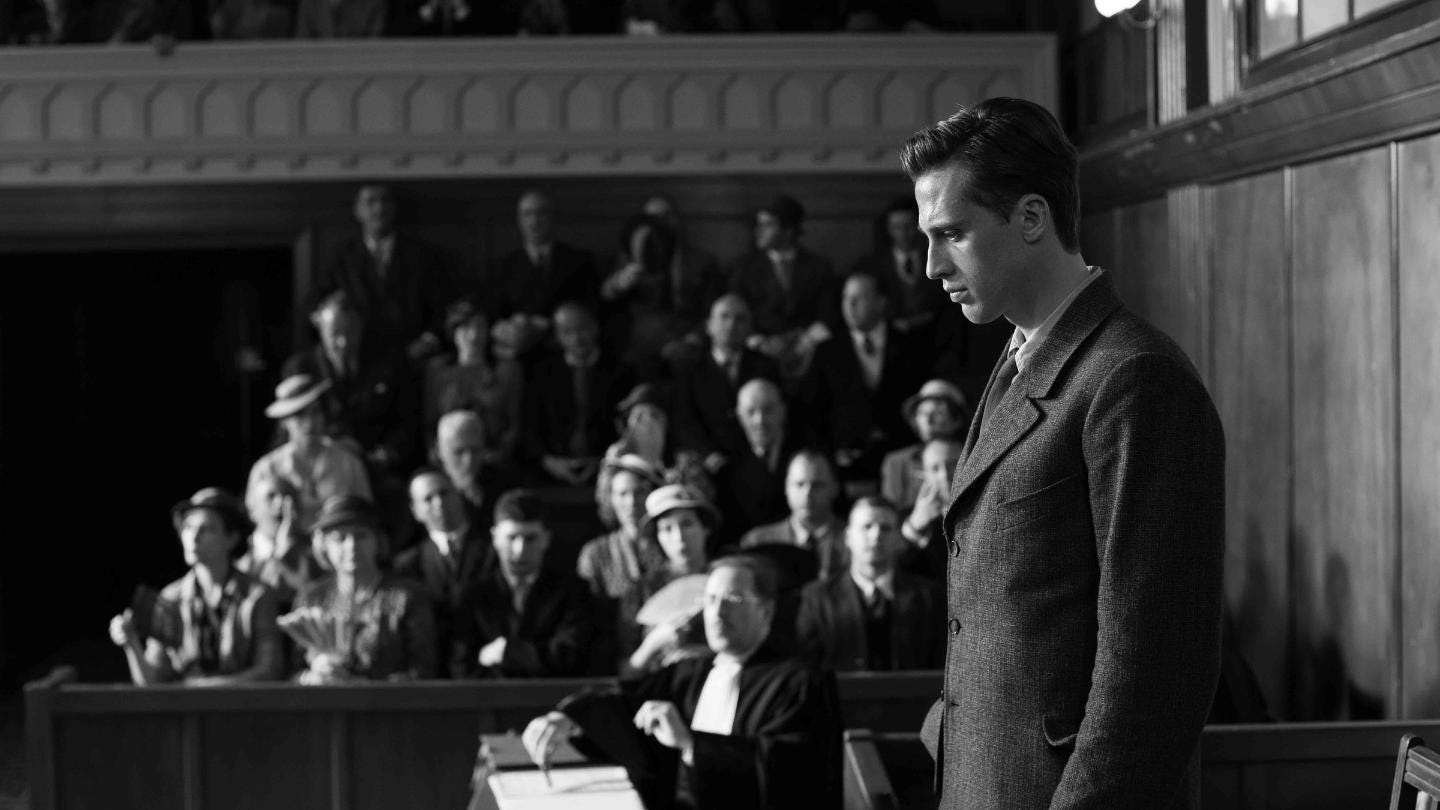
François Ozon’s new adaptation has first and foremost Benjamin Voisin’s beautiful, untroubled face and the story of this most non-engaging man set in the French Algiers. Meursault, a young French clerk in colonial Algiers, receives word that his mother has died in a rest home outside the city. He travels to the funeral, fails to behave with the grief expected of him, returns to Algiers, reunites with Marie, resumes the small routines of appetite and weather, and drifts into the orbit of Raymond Sintès, a neighbor whose violence toward an Arab woman will pull Meursault toward a confrontation on the beach. There, under a sun so bright, Meursault shoots an Arab man. The second half of the story is all that follows: prison, lawyers, priest, courtroom, sentence.
A large part of what makes The Stranger feel newly legible to me is that the movie adaptation feels contemporary despite an older setting, and Meursault is more than an exotic philosophical specimen. We have many Meursaults around us now if one looks carefully, as well as more available costumes for becoming one (for better or for worse!): men emptied out of inherited belief, men thinned out by disbelief, suspicious of sentiment and moral language, proud of not pretending, and those mistaking emotional nonparticipation for honesty and moral emptiness for intelligence. The old institutions that used to supply ready-made meanings—religion, family duty, patriotic myth, a stable idea of masculine honor—are all weakened and under attack, and into that vacancy rushes drift. I feel that I personally know many people for whom this emotional withholding is a means for intellectual superiority honesty and rationalism. One of the film’s sharpest modern fears is the lonely man whose emptiness makes him useful to someone else’s resentment, and I feel this to be particularly contemporary; we live today inside machines built to harvest our reactions.
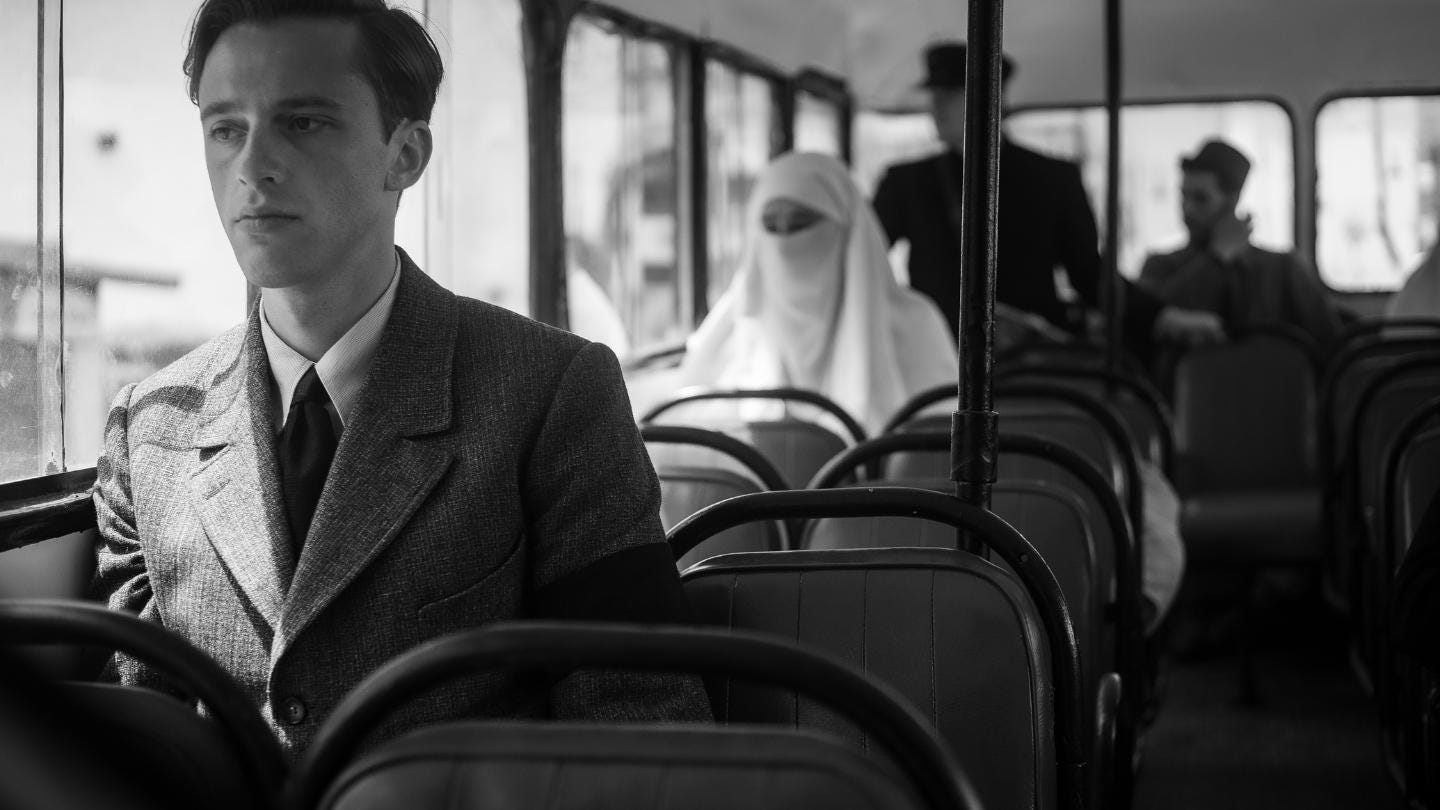
Camus’s prose is the prose of a flat sea. To put a camera on a book built on refrain, and out of the interior of a man who famously doesn’t seem to have one, is at risk of both undersaying and overspecifying; Ozon keeps the narration sparse, like salt in a soup, and chooses to externalize the perceptions Meursault provokes. We watch the way other people look at him. The disapproving attendant at his mother’s vigil, neighbors Salamano (a magnificent Denis Lavant, all whiskers and weather; Uzay says he’s reminded of Beau Travail and I wonder if Denis, who played in both, is a reason why) and Raymond, Marie (Rebecca Marder, luminous and hopeful but slowly dimming) waiting for him to mean what she means. I think there is a way to do this really badly, e.g. by making Meursault a cipher and calling it a day. Voisin is too handsome, too gently arranged, and I keep trying to read meaning into his face like we all try to read meaning into Alain Delon or into early Brando. Some part of us wants him to be redeemable and empathise with him because of it, and because this is this antihero’s story. I think a lot of bewilderment of people who will watch this movie will probably come from trying to fit Meursault in a box; the right way to enjoy him is one of curiosity. I for one was deeply amused by people’s misunderstandings of him, and his of people around him. The interactions were just deeply quite funny to me.
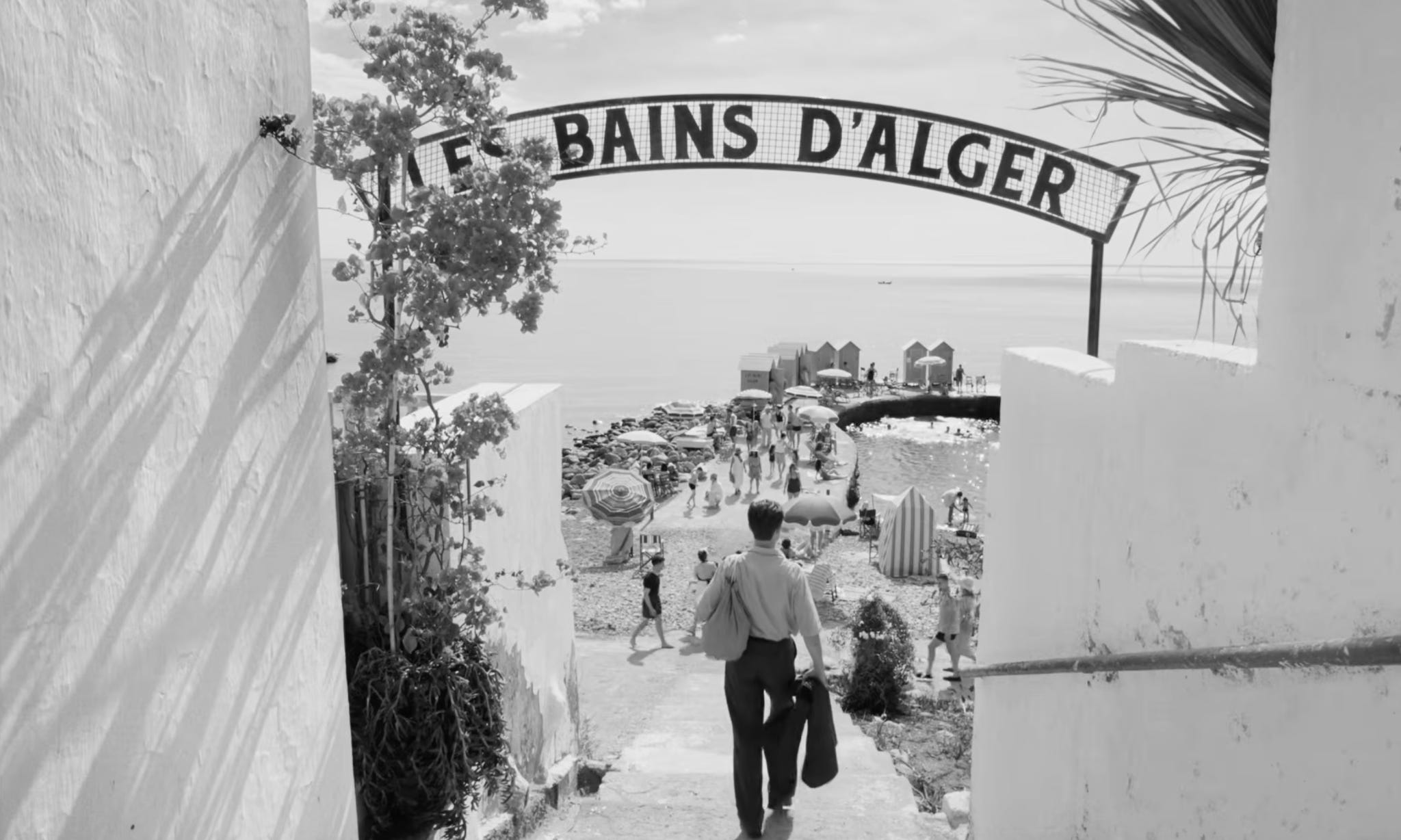
Manu Dacosse’s black-and-white cinematography is full of images that are sterling and almost sensuous. There have been a few television shows lately with excellent black-and-white cinematography work (shoutout Better Call Saul), but I’ve not seen that executed amazingly in movies for a while. Black and white matches and sanctifies the archival memory of French Algeria, and makes I think each frame more legible, letting me stay longer and more slowly on the salt on skin, the sun on hair, the mouths held too long in the frame. The long swimming scene of Meursault and Marie, played by Rebecca Marder, in the water, slick and laughing, is perhaps my favorite in the movie. As far as I was able to notice, it was the only scene we see Meursault laughing, being truly joyous, though momentarily. Marie is trying to understand whether this man’s passivity is freedom, cruelty, honesty. In the water, for a little while, his emptiness resembles ease. He likes swimming, cigarettes, sex, sleep. This is important because Meursault isn’t an ascetic.
Ozon has been candid about wanting to make everything in the film erotic, including the choice of Meursault and Marie’s casting, and strikingly the murder scene, which in Camus is already a small heat-stroke of stiffening and trigger-pulls and an underbelly the narrator describes as smooth. Hands, eyes, and lips are locked, the close-up shot of the Arab’s armpit and much else is staged very curiously with the slowed and eroticized grammar of a Leone duel. In my viewing of the movie, the flatness with Marie, his easy availability to Sintès, and his held gaze on a stranger’s mouth in the sun are all part of this single connected thread essential to understand the kind of romantic ennui and indifference Meursault has to the outside world.
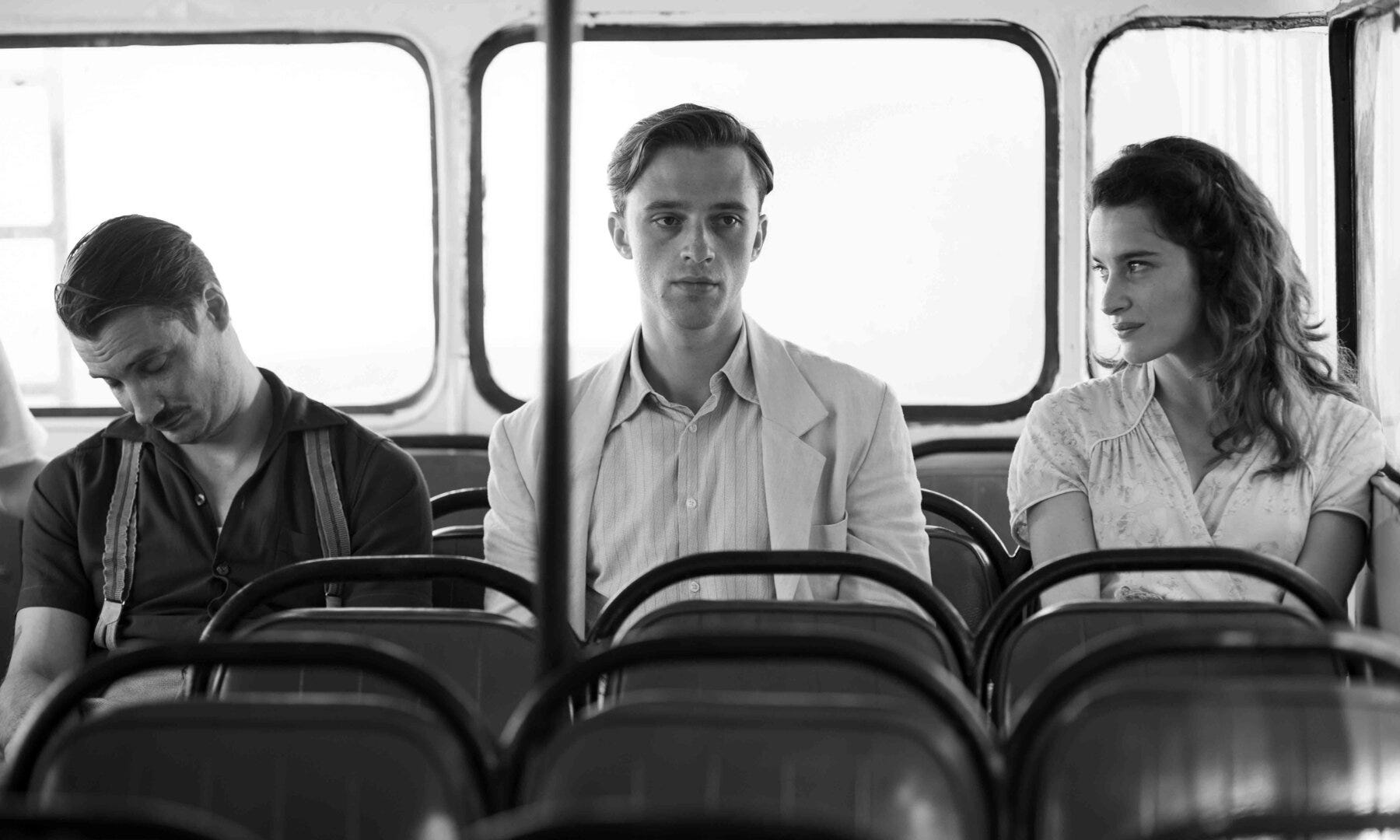
The film spends time on non-events, which I quite like: Meursault smoking, walking, sitting, looking at people, looking into space; Meursault just receiving the world around him as it goes on. The movie’s slowness is more than just a decorative art-house quality. He moves through Algiers as if life were something arranged for his passage. The emptiness around him is existential. It is social. It has colonial textures. It is masculine. This is why the early scenes matter so much. Meursault is first on trial for having the cigarette beside the coffin, the dry eyes at the vigil, the swim and cinema the next day, the (frightening to many) possibility that a man might pass through rituals of life without offering society the expressions by which it recognizes a soul. The viewer, you, have already been asked to measure his face against the expected forms of grief. The movie lingers there and society lingers there.
The film also spends time on pleasure, and this I think is essential. Meursault is not devoid of feeling, he is very much inside sensation and still can’t or won’t convert it into attachment. The film spends time on physical pleasure in order to show the precise poverty of his soul: he can receive the world, but he cannot answer it with responsibility.
Just as importantly, the movie spends time with Raymond and Salamano. Raymond’s violence toward his Arab mistress and Salamano’s cruelty toward his dog prepare the moral climate of the film that will follow, and they show a world in which domination is casual and domestic. Meursault is ‘just’ a consentor to the brutality in the world around him by drifting alongside it. Only the performance of remorse seems to be required in this world to go on to have normal lives after killing an Arab and serving a short sentence. Ozon spends more time on the Algerian presence of racial order, the victim and his sister, that the original novel pushed to its margins. Even when the Arab man is given a name (he did not have one in the book), the social machinery will be able to roughly erase him, and the court will fail to see. Over the credits, The Cure’s ‘Killing an Arab’ is played, which is the 1979 single Robert Smith wrote at nineteen as a direct response to the novel, and is a song chronically misread, its lyrics changed constantly over the decades. To me it felt a quite lovely choice of ending a film of austere mid-century existential weight with that.
The trial is very interesting; we hear much about Meursault’s mother and the events following her death, perhaps more than we hear of the Arab. Everyone knows Meursault killed the Arab. The trial is about whether collectively, a story can be produced in which his killing makes sense. The chaplain scene that follows is the film’s last trial. The priest is another kind of prosecutor, one who uses softer worse but is actually more invasive in purpose. This is the last attempt, one that comes at a breaking point, by the outside world to convince Meursault that he would benefit from accepting that guilt leads to repentance, repentance to salvation and suffering to meaning. Meursault’s indifference breaks into anger at this point. He becomes violently present now. Meursault hears only another social demand when he hears the chaplain’s offers, another performance required of him by men who cannot bear that his life may have no final explanation.
The part of the film that will stay with me most for a while is that both until the moment he fires the gun and even after it, he is a stranger, yet perfectly at home in the world that made him.